John kills Matheson and buries his body in the nuns’ cemetery
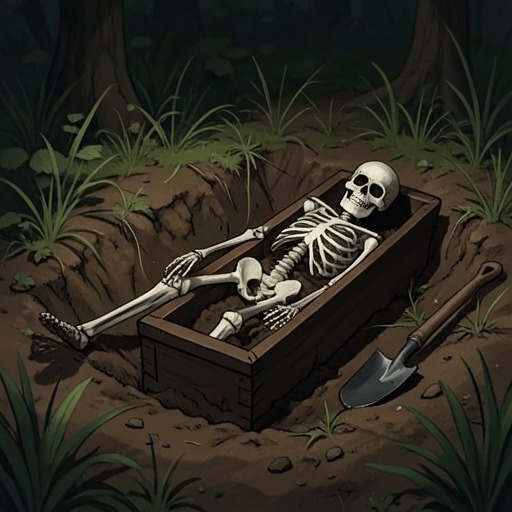
The Thursday Murder ClubJohn kills Matheson and buries his body in the nuns’ cemetery, an act disclosed decades later when John explains the identity of the hidden dead man and the reason he chose that burial place. His account turns a concealed grave into the record of a spur-of-the-moment killing, a deliberate evasion of discovery, and a decision that shaped where he and Penny would eventually retire.
The Visit to Greyscott
John places the killing in the early 1970s, at Greyscott, a sheep farm roughly ten miles away. He had begun work as a veterinarian around 1967, though he says Penny would remember the date more accurately, and had visited the farmer, Matheson, from time to time. On this visit, a mare had given birth to a foal that died. The mare was in severe distress, and Matheson did not want to shoot her. John understood his reluctance and gave the animal an injection to end its suffering, a procedure he says he had performed many times before and since. He contrasts Matheson and himself with farmers and veterinarians who would shoot a suffering horse.
Afterward, Matheson made John tea, and they talked. John recalls that he was usually in a hurry, while Matheson seemed lonely: he had no family, no one to help him on the farm, and little money. John remembers the day as bleak and says Matheson did not want him to leave. The account does not present a long-planned murder. Instead, John describes a sudden decision formed as he interpreted Matheson’s distress through the suffering he had just witnessed in the mare. He imagined that if Matheson had been an animal, he would have been screaming.
The Injection and Its Consequence
John says he reached into his bag and offered Matheson what he described as a flu shot to help him through the winter. Matheson accepted, rolled up his sleeve, and received the same injection John had just given the mare. John identifies the drug as pentobarbital and says it ended Matheson’s pain. His account therefore links the killing directly to the preceding veterinary treatment: the drug and the act of administering it were already at hand, but the human death followed a decision John made in the moment.
When asked whether he had put Matheson out of his misery, John says that was how he understood the act then and still understood it at the time of his confession. He also acknowledges what he would have done differently if he had been thinking clearly: he might have prepared a substance that would not appear in a post-mortem and left Matheson to be found by a postman, a milk van, or whoever next came to the farm. Instead, he had used pentobarbital, and feared that discovery of the body could lead someone to investigate. That concern changed the problem from how to explain the death to how to hide the body.
Choosing the Cemetery
John says he would have buried Matheson at the farm, but feared that builders might uncover him. In those years, he recalls, farmland was being bought up for housing development. He did not want a grave he had made to be exposed by construction soon afterward, so he thought of the convent cemetery. He knew it from visiting Gordon Playfair and considered it a place unlikely to be disturbed: it was not farmland, he believed no one would buy a convent, and he knew the cemetery was quiet and rarely visited.
A couple of days after the killing, John drove there at night with his lights off, took a spade, and buried Matheson. The practical details make the concealment a planned response to the risk of discovery, even though John describes the killing itself as an impulsive act. The burial was not simply an immediate disposal at the farm; it placed Matheson among the dead in a location John judged less vulnerable to redevelopment and attention.
The Secret That Followed Him
John says the grave remained undisturbed for forty years, until he saw an advertisement for Coopers Chase. He persuaded Penny that it would be a lovely place to retire, and says he was right about the place as a home. But his reason for choosing it was not only the prospect of retirement: he wanted to keep an eye on the cemetery. Although he had assumed a graveyard would not be dug up, he recognized that it might happen, and wanted to be nearby if the danger became real.
The confession thus reveals a long consequence of the burial. John’s secret did not end when he covered the grave; it became part of the logic behind his later move with Penny. The cemetery that had seemed a safe hiding place also became something he felt compelled to monitor. In the present conversation, questions from Joyce and Elizabeth draw out the story, while John’s account connects the hidden remains to his own continuing proximity. The act’s significance lies in that double movement: a sudden death concealed in a place chosen for its apparent permanence, followed decades later by a retirement shaped in part by fear that the concealment might fail.